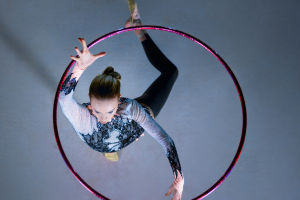
Figure skating spins often look effortless, almost magical, as skaters rotate rapidly before slowing down with perfect control.
Behind this elegance lies a precise combination of physics and human skill. Every spin is governed by scientific principles such as motion, balance, and rotational dynamics.
Understanding these concepts reveals how skaters are able to control speed, stability, and direction with remarkable accuracy on ice.
Conservation of Angular Momentum
At the heart of every spin is a principle called conservation of angular momentum. When a skater begins a spin with their arms extended, their body rotates with a certain angular momentum that remains constant unless an external force such as air resistance or friction from the ice acts on it.
When the skater pulls their arms and legs closer to the body, they reduce their moment of inertia. In simple terms, this means their mass is distributed closer to the axis of rotation, making it easier for them to spin faster. As a result, the rotational speed increases significantly, creating the appearance of a rapid, controlled blur.
Staying Centered and Balanced
A key part of spinning successfully is maintaining balance over the blade. Skaters do not spin on the toe pick; instead, they use the curved middle section of the blade designed for controlled rotation.
To stay centered, they align their body directly over this pivot point and make continuous, subtle adjustments using core strength and posture control. Even small shifts in body position can affect stability, so precision is essential throughout the spin.
Friction and Controlled Stopping
Friction plays an important role in both sustaining and slowing spins. The contact between the blade and ice creates a thin layer of water due to pressure and slight surface melting, which helps reduce friction and allows smooth rotation.
Over time, air resistance and ice contact gradually slow the spin. To stop, the skater extends their arms and legs outward, increasing their moment of inertia and naturally reducing rotational speed, similar to how spreading out mass slows rotation in any spinning system.
Types of Spins and Movement Control
Different spin positions create different rotational effects. A tight spin position produces the fastest rotation because the body is compact and close to the axis. A more extended position, such as when one leg is stretched outward, increases the moment of inertia and results in a slower but more expressive spin.
Transitions between positions require careful timing. Skaters must adjust their body alignment smoothly while maintaining angular momentum to avoid losing balance or speed.
Maintaining Orientation During Rotation
To avoid dizziness, skaters use a technique that involves focusing on a fixed point in their surroundings. They keep their gaze locked on a single reference point during each rotation and quickly refocus it with every turn.
This helps the brain manage sensory input from rapid rotation and supports stability during complex spinning sequences.
Figure skating spins are a perfect example of physics in action, combined with human precision and control. What appears effortless is actually the result of carefully managed forces, body positioning, and timing. Each movement reflects a deep understanding of balance and motion, transforming scientific principles into a visually stunning performance on ice.